
Mango Macarons
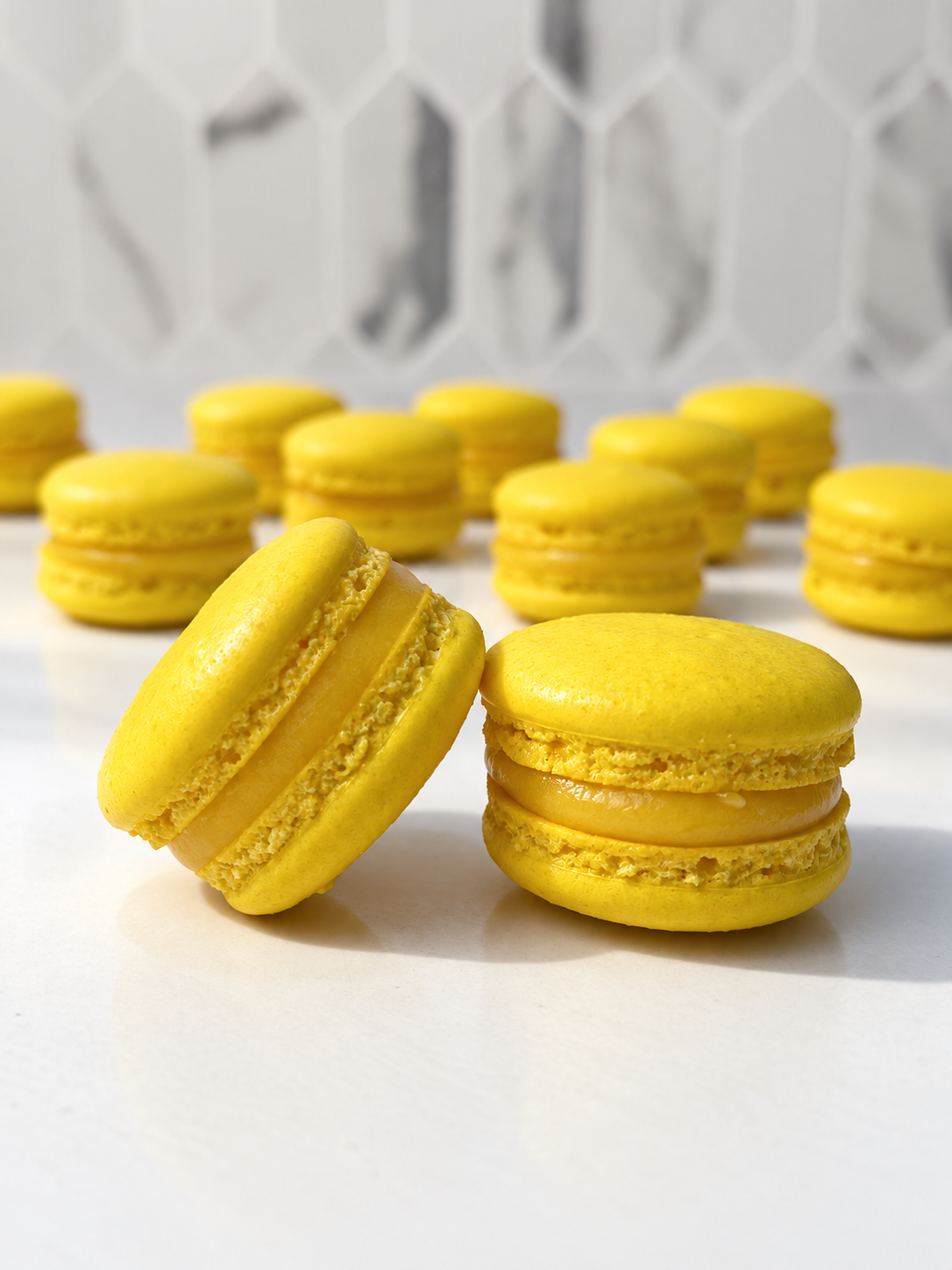
If you’ve ever wanted to make macarons at home, this mango version is a lovely place to start. Delicate macaron shells are filled with a creamy mango white chocolate ganache and a bright mango-lime center. I prefer using a French meringue for these macarons because it is quicker to prepare and more approachable for beginners.
Yield: about 15 macarons
Prep time: about 1 hour 15 minutes
Bake time: 12–14 minutes
Resting time: at least 4 hours for the ganache + 30–40 minutes drying + 24 hours maturation
Equipment
kitchen scale
stand mixer or electric hand mixer
blender or immersion blender
fine-mesh sieve
silicone spatula
small saucepans
kitchen thermometer
piping bags
approximately 8 mm round piping tip
baking sheet
silicone macaron mat or parchment paper
Ingredients
Homemade Mango Purée
200 g frozen mango chunks
Mango Ganache
100 g white couverture chocolate
55 g mango purée
8 g unsalted butter
4 g fresh lime juice
Mango Filling
70 g mango purée
8 g granulated sugar
3 g cornstarch
3 g fresh lime juice
Macaron Shells
70 g egg whites, room temperature
70 g granulated sugar
91 g almond flour
91 g powdered sugar
yellow or orange gel or powdered food coloring, as needed
Instructions
1. Make the Mango Purée
Thaw the frozen mango chunks completely.
Place the mango and its juices in a small saucepan and cook over low heat for 5 minutes, just until the fruit softens.
Blend until completely smooth using a blender or immersion blender.
Pass the purée through a fine-mesh sieve to remove any remaining fibers. If the purée still looks very thin, return it to the saucepan and cook gently for a few more minutes, stirring frequently. The finished purée should have the consistency of a thick fruit coulis rather than a juice.
Let it cool, then weigh the amount needed for the ganache and mango filling.
2. Make the Mango Ganache
Gently melt the white chocolate in the microwave in short intervals.
Heat the 55 g mango purée until hot, without letting it boil for an extended period.
Gradually pour the hot mango purée over the melted white chocolate, stirring firmly to create a smooth emulsion. Continue mixing until the ganache looks glossy and completely homogeneous.
Once the mixture cools below 104°F / 40°C, add the butter and lime juice. Blend with an immersion blender, keeping the blade fully submerged to avoid incorporating excess air. The finished ganache should be smooth, glossy, and fully emulsified.
Cover directly with plastic wrap and refrigerate for at least 4 hours, or preferably until the ganache is firm enough to pipe while still remaining creamy.
3. Make the Mango Filling
In a small bowl, combine the sugar and cornstarch.
In a small saucepan, add the 70 g mango purée, sugar and cornstarch. Cook over medium heat, whisking constantly. Once the mixture thickens and begins to bubble, maintain a gentle boil for approximately 30 seconds, stirring continuously to fully cook the cornstarch.
Remove from the heat and stir in the lime juice. The mango filling should be thick enough to hold on a spoon without running, while still remaining creamy rather than firm or gummy.
Cover directly with plastic wrap and refrigerate until completely cold.
Once chilled, stir gently with a silicone spatula to restore a smooth, soft, pipeable consistency.
Macaron Shells
4. Prepare the Dry Ingredients
Combine the almond flour and powdered sugar. Pulse very briefly in a food processor, just to refine the mixture without heating the almond flour.
Sift through a fine-mesh sieve. The dry ingredients should be fine and evenly combined, which helps produce smoother macaron shells.
5. Make the French Meringue
Place the egg whites in a perfectly clean mixing bowl. Begin whipping at medium-low speed.
Once the egg whites become foamy, gradually add about one-third of the granulated sugar. Continue whipping.
When the whites become more opaque, add the second third of the sugar.
Add the remaining sugar once the meringue begins to increase noticeably in volume. Continue whipping until the meringue is smooth, glossy, and firm. When you lift the whisk, the meringue should form a peak that holds its shape, although the very tip may bend slightly.
Add the food coloring toward the end of whipping and mix only until the color is evenly distributed.
6. Macaronage
Add the sifted dry ingredients to the meringue all at once.
Begin folding gently with a silicone spatula until the dry ingredients are mostly incorporated.
Then begin the macaronage. Fold the batter from the bottom of the bowl toward the center while rotating the bowl as you work. Occasionally press some of the batter against the side of the bowl to gently deflate it.
Stop when the batter becomes glossy and flows from the spatula in a continuous ribbon. Use the figure-eight test: you should be able to draw a figure eight with the batter without the ribbon immediately breaking. The lines left on the surface should gradually disappear back into the batter within approximately 10 to 15 seconds. If they disappear almost immediately, the batter has likely been overmixed.
Transfer the batter to a piping bag fitted with an approximately 8 mm round piping tip.
Pipe circles 3.5 cm in diameter. If you want more evenly sized macarons, you can use a printable macaron template and place it underneath the parchment paper or silicone mat while piping. Simply slide the template out before baking.
Hold the piping bag completely vertical at a 90-degree angle, approximately 5 mm above the baking sheet. Pipe without making a circular motion. Stop applying pressure before quickly lifting the piping bag away.
Firmly tap the baking sheet against the counter 2 to 4 times to release trapped air bubbles.
Pop any remaining large bubbles with a toothpick.
Allow the piped macarons to rest at room temperature for approximately 30 to 40 minutes. The exact time will depend on the temperature and humidity of your kitchen. Very gently touch the surface of one shell with your fingertip. The surface should feel dry and no batter should stick to your finger. If it is still tacky, allow the macarons to rest longer before baking.
7. Bake the Macaron Shells
Preheat the oven to 285°F / 140°C convection.
Bake one tray at a time on the center rack for approximately 12 to 14 minutes. The macarons should develop an even ruffled foot, and the tops should remain stable. Toward the end of baking, very gently touch the top of one macaron. If the shell easily shifts or wobbles over the foot, bake for another 1 to 2 minutes.
Allow the shells to cool completely on the baking sheet before removing them. Properly baked macaron shells should release cleanly without leaving the bottom stuck to the mat or parchment paper.
Assembly
8. Fill the Macarons
Match the cooled shells into pairs of similar size.
If necessary, gently stir the chilled mango ganache with a spatula to soften it slightly before transferring it to a piping bag fitted with a small round tip.
Pipe a ring of mango ganache around the edge of one shell, leaving a small empty space in the center.
Pipe the mango filling into the center.
Place the second shell on top and press down very gently until the filling spreads toward the edges without squeezing out.
Maturation
Place the assembled macarons in an airtight container and refrigerate for at least 24 hours before serving. This maturation period is an important part of making macarons. Moisture from the ganache and mango filling gradually softens the interior of the shells while preserving their delicate outer crust.
For the best texture and flavor, remove them from the refrigerator 15 to 20 minutes before serving.
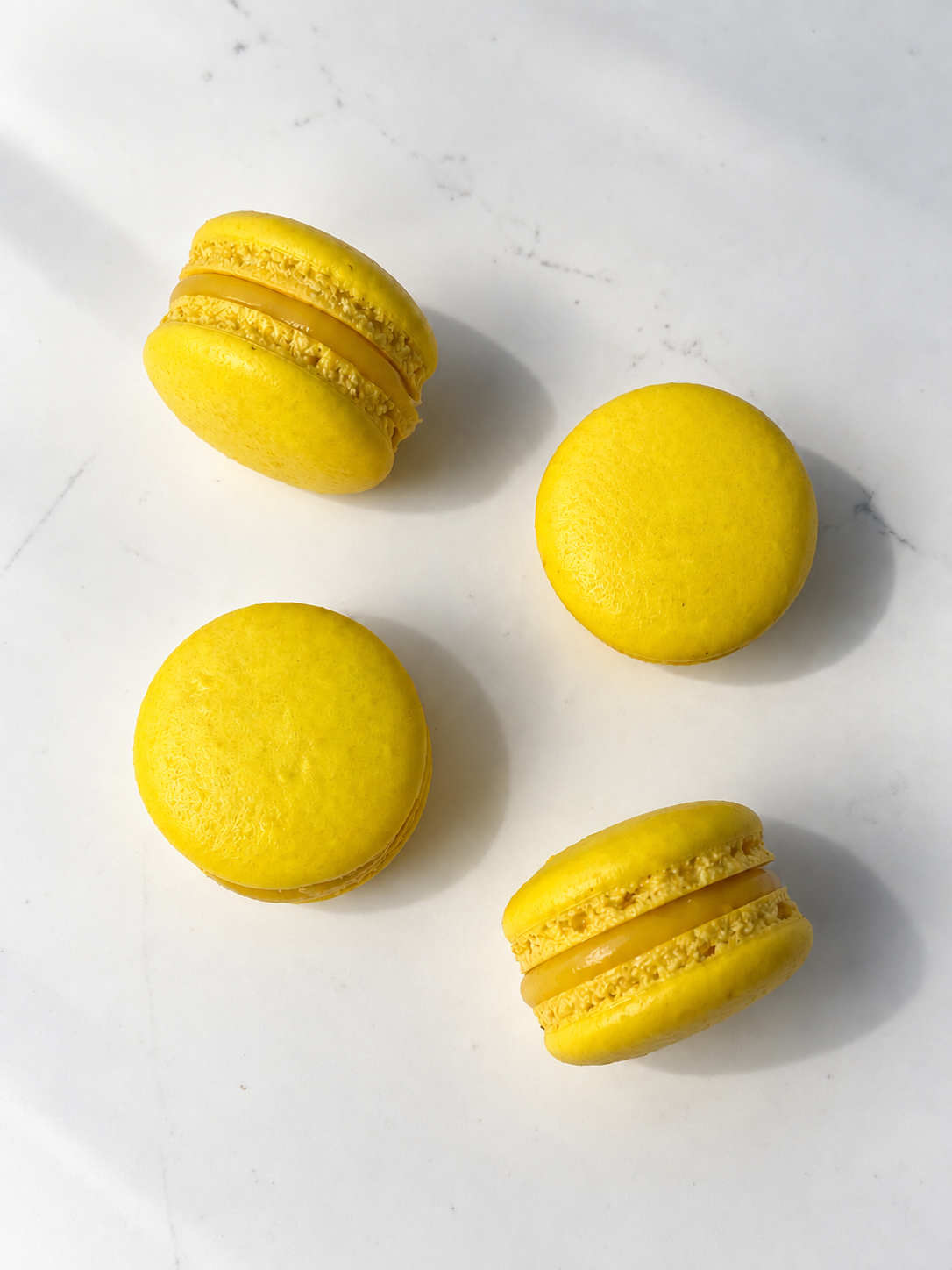
Mathilde's Tips
Do not overmix during macaronage. Batter that is too fluid will spread excessively and produce flat shells. Stop once the batter flows smoothly and the lines disappear within about 10 to 15 seconds.
Choose concentrated food coloring. Gel or powdered food coloring is preferable to liquid coloring, which can add unnecessary moisture to the batter.
Adjust the baking time to your oven. Every oven behaves differently. If they remain sticky underneath or wobble on their feet, they usually need a little more baking time.
Watch the consistency of the mango purée. Very watery purée can make the ganache too soft and dilute the flavor. Reduce it gently before measuring if necessary.
Do not skip maturation. Freshly assembled macarons are not at their best. After about 24 hours in the refrigerator, the texture becomes softer and much more balanced.
Make ahead. The mango purée, mango ganache, and mango filling can all be prepared the day before and kept covered in the refrigerator until ready to use.
Storage
Store the filled macarons in an airtight container in the refrigerator for approximately 3 to 4 days.
For the best texture and flavor, remove them from the refrigerator 15 to 20 minutes before serving.
Freezing
Assembled macarons can be frozen for approximately 2-3 months in an airtight container.
To thaw, transfer the closed container directly from the freezer to the refrigerator and leave it there for several hours or overnight.
Once thawed, let them sit at room temperature for about 15 to 20 minutes before serving.